
Intercompany pricing policies are an internal governance framework a multinational group uses to establish and justify the terms, conditions, and pricing of transactions between related legal entities. While the arm's length principle defines the required regulatory outcome, the intercompany policy defines the operational roadmap: the selected method, the target margin or rate, the necessary data inputs, and the functional owners accountable for its execution and monitoring.
What policies typically cover?
A complete framework addresses every material category of intercompany transaction, and each category carries its own technical requirements that a generic policy template tends to flatten.
Tangible goods and inventory movements. Transfer prices for products sold between group companies, set by entity type (limited-risk distributor, commissionaire, full-fledged distributor) rather than uniformly across the group.
Intra-group services. Which services the group charges for, the cost base, the markup, and the allocation keys used to split costs across recipients. The policy tipically describes the framework for how benefits are identified and evaluated to determine whether a service provides economic or commercial value.
Intangibles and royalties. A framework governing the pricing, ownership, and risk allocation for the transfer, licensing, or joint development of intellectual property (IP) and other intangible assets between related group entities. Policies specify which entities license the IP, the applicable royalty rate, and the valuation basis for that rate. Crucially, they address legal versus economic ownership by defining which entities actually perform, control, and financially support the DEMPE functions (Development, Enhancement, Maintenance, Protection, and Exploitation) in alignment with OECD guidelines.
Financing. Interest rates on intercompany loans, cash pooling terms, guarantee fees, and captive insurance, benchmarked against credit ratings and market data. Policies specify maturity profiles and pricing methodologies. Crucially, they address capital structure, debt capacity, and implicit support—evaluating how group membership affects a borrower's credit rating and borrowing costs to ensure terms reflect arm’s length standards.
Key elements of an Effective Transfer Pricing Policy
A comprehensive intercompany pricing policy establishes the governance and compliance baseline by setting out:
The selected method and Rationale. Which transfer pricing method is used for each transaction type, along with a clear justification of why that method is the most appropriate under the circumstances.
Comparability Factors. How comparability is assessed based on FAR profile: functions performed, assets used, risks assumed, along with contractual terms, economic circumstances, and business strategies.
Contemporaneous Documentation. What records and documentation are required to substantiate compliance with the arm’s length principle. This includes aligning with the OECD Chapter V three-tier standard (Master File, Local File, and Country-by-Country Report) and ensuring that the policy, legal agreements, and documentation maintain a single, consistent narrative that accurately reflects the group’s functional profile and defends its global tax position.
Review Frequency. How frequently prices and functional profiles are monitored and reviwed, reflecting OECD guidance on annual testing and periodic economic updates.
Year-End Adjustments and True-Ups. How year-end accounting adjustments are handled to bring results into arm’s length range, with careful considerations of potential interactions with customs, VAT, or other non-tax rules.
To operationalize these governance standards, the policy must translate the framework into practical mechanics. For each specific transaction category (e.g., services, intangibles, goods), a robust intercompany pricing policy should define four core operational elemements:
Transfer Pricing Method. The legally defensible methodology applied (e.g., CUP, TNMM, Cost-Plus, or Profit Split).
Target Financial Outcome. The arm’s length pricing standard, markup or profit level indicator (PLI) range (e.g., interquartile benchmark range, or specific royalty rate).
Data Inputs and Implementation. Operational variables required to execute the pricing-including cost bases, allocation keys, market data, and benchmarking parameters.
Governance and Ownership. Designated operational and functional owners responsible for calculating, applying, reviewing, and monitoring the policy. responsible for applying and monitoring it.
How do you build and maintain a pricing policy?
The build follows a repeatable sequence, and the last step is the one most frameworks underinvest in.
- Map the transactions. Identify every material intercompany flow:: who sells what to whom, and for how much. Most groups find flows they didn't know existed.
- Characterize the entities. Determine each party's functions, assets, and risks; a limited-risk distributor warrants a different policy than a full-fledged entrepreneur.
- Select methods and set targets. Choose the transfer pricing method for each transaction type and support the target with benchmarking, not convention.
- Document and communicate. Write the policy in terms finance teams can execute, not only terms a tax authority will accept.
- Monitor and adjust. Track actual results against policy targets during the year, not after it closes, and correct drift with in-year price changes rather than large year-end true-ups.
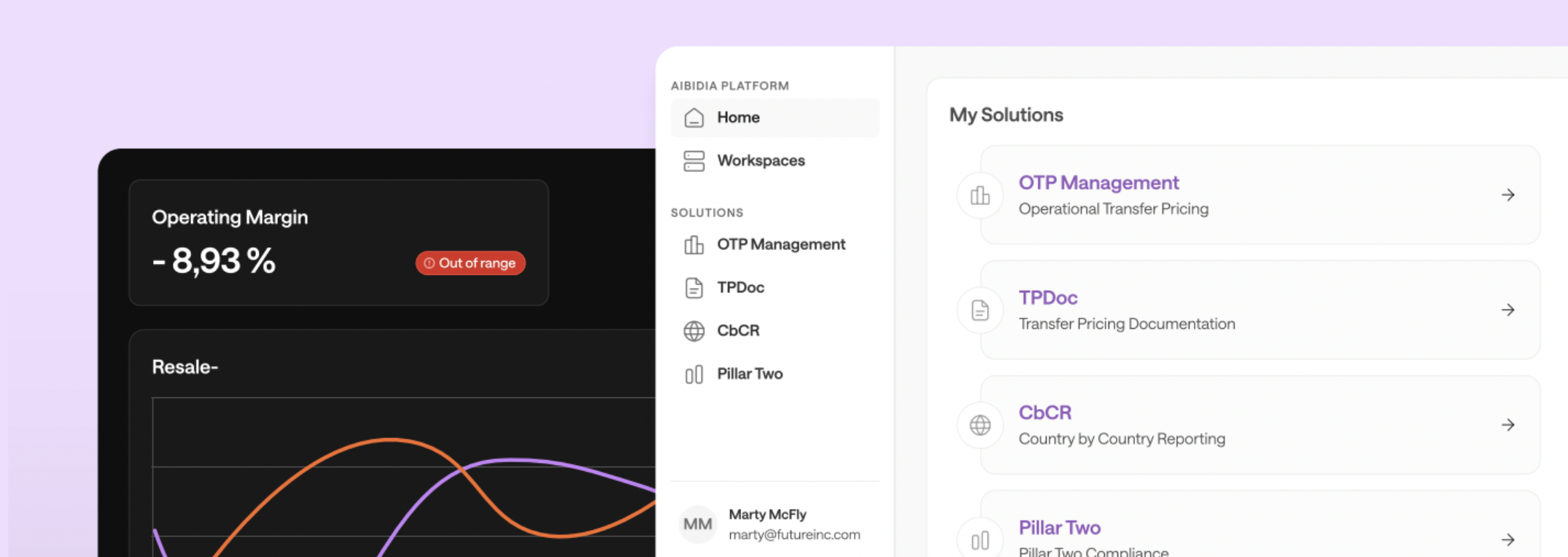
Steps one through four are periodic. Step five is continuous, and it's where most policy frameworks quietly fail. The policy lives in a document while results live in the ERP, and nothing connects the two until documentation season, by which point the correction is a true-up rather than a course adjustment. Aibidia's platform closes that gap by linking policy targets to live entity results, so teams see segmented margins against their policy ranges during the year, while there's still time to act, the operational half of Operational TP Management, where setting the rule is only half the job.
How often should policies be reviewed?
At minimum annually, to align with business and regulatory change. But four triggers should prompt an off-cycle review regardless of the calendar: entering a new market, where local law may override or narrow the group's default method; a restructuring, acquisition, or new product line that changes the functional profile of an entity the policy already covers; a material shift in financial conditions, such as an interest rate move that outdates a financing policy's benchmark; and any tax audit or dispute, which routinely surfaces gaps between policy and practice that a scheduled annual review would have missed anyway.
What are the most common pitfalls?
- A policy the entities don't actually follow. A precisely drafted policy that operations ignore is worse than no policy, because it creates a written standard the group visibly fails to meet, and tax authorities read the policy and the financials side by side.
- Correcting drift only at year-end. Large true-ups are harder to explain than small in-year corrections, and they carry customs and VAT exposure the transfer pricing team doesn't always anticipate.
- Applying safe harbors outside their scope. most often the low value-adding services markup applied to functions (core business activities, R&D, manufacturing) the simplification was never meant to cover.
- Letting the intercompany agreement drift from the policy and from actual conduct. Under an accurate-delineation standard, the contract doesn't settle the analysis if the parties' conduct says something different.
- Treating the policy as annual paperwork rather than living infrastructure. Review triggers exist for a reason; waiting for the calendar to force a review means the business has already outgrown the policy by the time it's revisited.